MelPump ›MelPump data · 2026
How much does steering a heat pump by dynamic prices and solar power save? Data from nearly 300 homes (2026)
Steering a heat pump lowers the bill when it gets a chance to act. We checked this in the cost reports of nearly 300 homes. In autumn we studied steering by dynamic prices (Smart Energy), and in summer steering by power from the home's own solar panels (Solar Mode). For dynamic prices we count conservatively: only energy that the pump's own data shows the steering moved.
Last updated: · Dynamic prices: 20 October - 18 November 2026 · Solar Mode: 1 June - 31 August 2026
We update this report as new data comes in. In January 2027 we will add results from a full winter month, and in spring 2027 the measured result for the whole heating season.
Key findings
- When dynamic-price steering ran regularly, half of the homes cut their heat pump's electricity bill by at least 4.2% (20 October - 18 November 2026).
- In autumn, regularly steered homes saved a median of €4.21 a month with dynamic-price steering. In winter the pump uses much more electricity. For these homes we forecast about €46 over the whole heating season from price steering alone. We will publish the measured result in spring 2027.
- In autumn, 96% of homes with dynamic-price steering ended the study period with a saving. This includes homes where the steering rarely ran.
- In summer, Solar Mode, which steers the heat pump by the home's own solar power, cut the pump's electricity bill by at least 12.4% in half of all homes where it ran. Days marked as an early estimate account for 45% of the summer Solar Mode savings, as we explain below.
- The best results are much higher than the median. One in four regularly steered homes cut the pump's electricity bill by more than 6.9% with dynamic-price steering. With Solar Mode, 22% of homes cut the bill by 25% or more. Among all MelPump homes with a cost report, the best one saved €238 in 83 days (1 June - 18 November 2026), 16.5% of its heat pump's electricity cost. This counts both kinds of steering, and Solar Mode savings include early estimates. In both kinds of steering, savings grow with how often the steering runs.
- We estimate that a home using both kinds of steering saves about €61 a year. For the heating season, from October to April, we forecast about €46 from dynamic-price steering. In summer (1 June - 31 August 2026), Solar Mode saved about €15. This is the sum of typical results for regularly steered homes from both parts of the report, not a measurement of a full year.
- For dynamic prices we count only energy that the pump's data shows the steering moved. We do not include what the dynamic tariff saves on its own. The Solar Mode result includes an estimate and the assumption that solar power is free, as we describe below.
Dynamic prices: autumn results
Each bar shows the share of homes that saved a given part of their heat pump's electricity bill. Here the bill means what the pump would have cost to run without steering, at the home's own tariff, including per-kWh charges and VAT but not fixed fees.
These results cover dynamic tariffs with day-ahead market prices, for example Nord Pool spot prices. Such prices change many times a day. Tariffs with a single price or with fixed cheap and expensive hours offer far fewer opportunities, so we leave them out here. The Solar Mode results below cover all tariffs.
- Below zero 2%
- No saving 2%
- Under 1% 19%
- 1% to 3% 25%
- 3% to 7% 32%
- 7% to 15% 14%
- 15% or more 8%
The median for all homes with dynamic-price steering was 3.2%. One in four homes saved more than 6.3%. 96% of homes ended the period with a saving.
The more often steering runs, the more it saves
What matters most is how often Smart Energy gets to steer the pump. Each bar shows the median for homes that were steered about equally often.
- 0% to 25% of days 0.1%
- 25% to 50% of days 1.3%
- 50% to 75% of days 2.9%
- At least 75% of days 4.2%
We count a home as regularly steered when Smart Energy ran on at least 75% of days from its first day of steering in the study period. Half of these homes saved at least 4.2%. One in four saved more than 6.9%.
22% of homes saved less than 1%. Among homes where steering ran on fewer than 25% of days, as many as 94% did. How often steering runs depends on the settings and on how much prices change during the day.
Results by country
This section covers dynamic-price steering, without Solar Mode. We give savings as medians: half of the homes saved more and half saved less. We convert amounts in other currencies to euro at the exchange rate on 18 November 2026.
Euro area
20 October - 18 November 2026- Median share of the bill saved
- 3.5%
- Median saving per month
- €2.89
This group covers homes in several countries that pay for electricity in euro, on dynamic tariffs based on spot prices. Price levels and the size of price swings differ between countries.
Countries in this group: Austria, Belgium, Germany, Estonia, Finland, Ireland, Netherlands, Slovakia, Slovenia.
On average in this period, the three most expensive hours of each day cost 75% more than that day's average. The chart of hourly averages shows a smaller gap, because the peaks fall at different hours on different days.
From €0.07 to €0.15 per kWh, excluding fees and VAT.
Sweden (Nord Pool)
20 October - 18 November 2026- Median share of the bill saved
- 3.6%
- Median saving per month
- SEK 39.82 (€3.58)
Homes in Sweden with an hourly spot-price contract pay Nord Pool prices. The prices are set a day ahead and change many times a day. Smart Energy checks the prices for the coming hours and moves heating and hot water from the most expensive hours to cheaper ones.
On average in this period, the three most expensive hours of each day cost 45% more than that day's average. The chart of hourly averages shows a smaller gap, because the peaks fall at different hours on different days.
From SEK 1.27 (€0.11) to SEK 2.47 (€0.22) per kWh, excluding fees and VAT.
United Kingdom: Octopus Agile prices
We do not yet have enough homes in the UK for a reliable median. So we show the public prices that the steering adapts to. The figures are for the London region, 20 October - 18 November 2026. In the 16:00-19:00 evening peak, electricity cost an average of £0.59 (€0.71) per kWh. That is 56% more than the daily average. In the six cheapest hours of the day it was 24% cheaper than the average.
- Six cheapest hours £0.29 (€0.34)
- Daily average £0.38 (€0.45)
- Peak 16:00-19:00 £0.59 (€0.71)
From £0.29 (€0.34) to £0.60 (€0.72) per kWh, including VAT, excluding the standing charge.
A heat pump cannot move all of its consumption, because the house has to stay warm. On a tariff like this, avoiding the evening peak makes the biggest difference.
Solar Mode: steering by power from your own solar panels
Solar Mode runs the heat pump in the hours when the solar panels are forecast to produce the most power. In summer the pump then mostly heats hot water. We treat power drawn in these hours as free. The saving is the grid power the pump would have drawn for that water at other times, priced at the home's tariff.
In summer (1 June - 31 August 2026), half of all homes with Solar Mode cut their heat pump's electricity bill by at least 12.4%. One in four homes saved more than 23.3%.
- Below zero 1%
- No saving 3%
- Under 3% 15%
- 3% to 10% 25%
- 10% to 25% 34%
- 25% or more 22%
Not every kilowatt-hour from the panels replaces a kilowatt-hour from the grid. We work out how much it replaces for each pump separately, by comparing days with and without solar water heating. A pump that heats water with solar power almost every day has too few days without it to compare. We then use the typical share measured on other pumps, about 60%, and mark the day as an early estimate. Days marked as an early estimate, mostly for this reason, account for 45% of the summer Solar Mode savings.
For summer, we count a home as regularly steered when Solar Mode ran on at least 50% of days from its first day in use. Half of these homes saved at least 18.7%. One in four saved more than 25.8%.
- 0% to 25% of days 1.8%
- 25% to 50% of days 6%
- 50% to 75% of days 10.5%
- At least 75% of days 19.7%
In summer the pump uses little electricity, so even a large share of the bill is a small amount of money. Median monthly saving from Solar Mode:
- Poland: PLN 16.97 (€3.85) a month. Median share of the bill saved: 14.4%.
- Sweden: SEK 24.36 (€2.19) a month. Median share of the bill saved: 13.2%.
- Euro area: €2.71 a month. Median share of the bill saved: 9%.
In late autumn and winter the panels produce little, so Solar Mode then saves much less. In that season, dynamic-price steering does more.
How we calculate the savings
A saving cannot be read from a meter, because nobody can measure a bill that never existed. So we compare what the heat pump actually did with what it would have done without steering.
-
1
The pump's profile without steering
From hours when nothing was steering the pump, we learn how much electricity it uses at a given outdoor temperature, how much it draws on standby and when it heats hot water. Recent days carry more weight.
-
2
Only hours with steering
A saving counts only in hours when data from the pump itself shows that Smart Energy changed the temperature setpoint, or that Solar Mode started the pump in hours of forecast solar production.
-
3
Shifted energy
Around each steered hour we compare actual consumption with the profile. We count only energy that was held back and used later, or used earlier instead of later. We account for it within 4 hours after the steering, and beyond that only as long as the following hours are still making it up, at most until 24 hours after the last steered hour.
-
4
Priced at the home's tariff
We price the shifted energy at the home's tariff, including per-kWh charges and VAT. The saving is the price difference between the hours the energy was moved from and the hours it was moved to. We credit it to the day of the steering.
- Pump without steering
- With steering
- Heat made up in cheaper hours
- Expensive hours
A day without steering gives no saving, by definition.
What we do not count
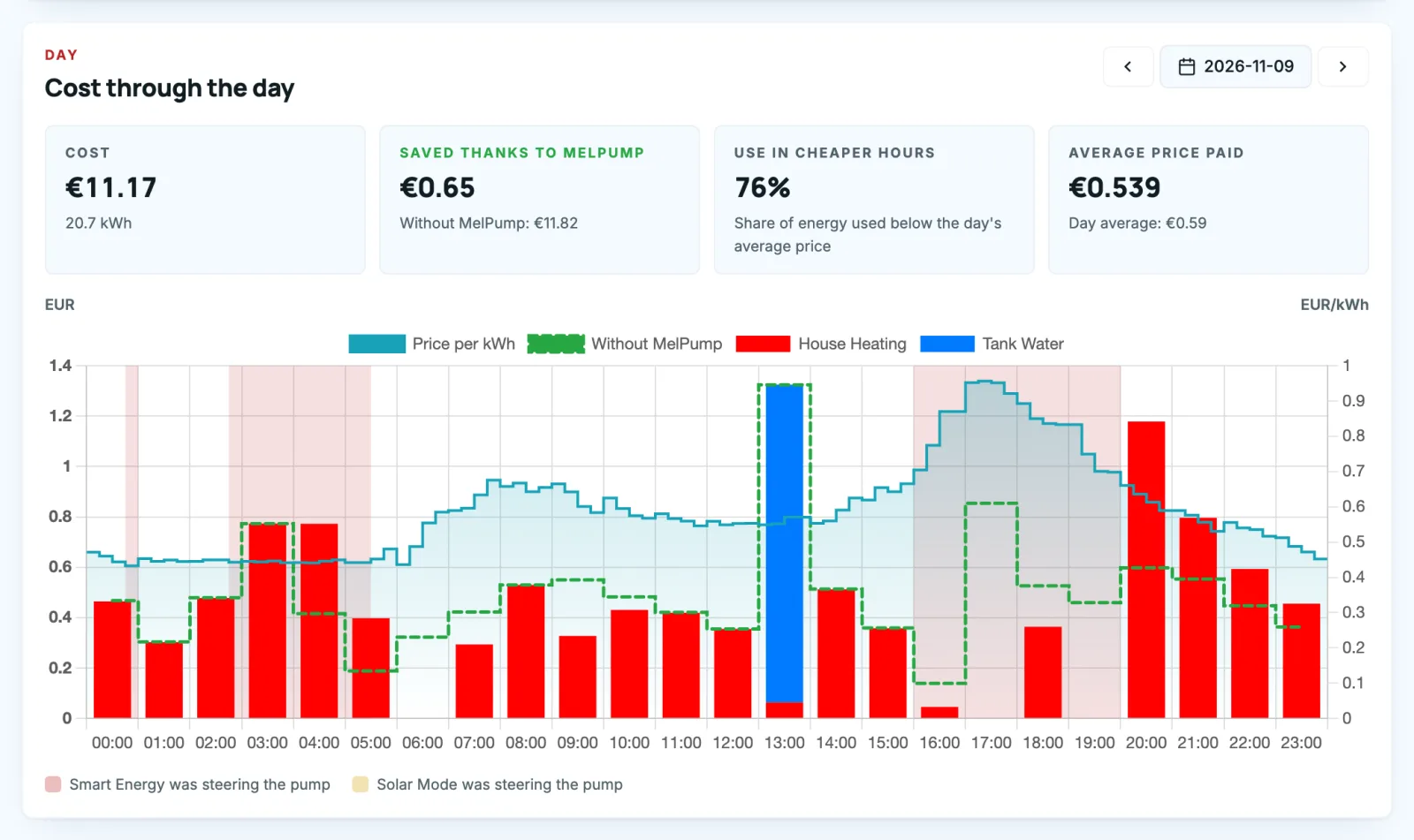
- The effect of the tariff itself. On a dynamic tariff, a heat pump already runs partly in cheaper hours without any steering. The cost report shows this separately as “Average price paid” and “Use in cheaper hours”.
- Energy made up only after a break, or later than 24 hours afterwards, even if the steering caused it.
- Energy held back in an expensive hour that the pump never made up later.
When the results are less accurate
- When the pump runs at an outdoor temperature it has not met in recent weeks, for example during the first frosts or shortly after connecting.
- On unusual days, for example when there are guests in the house, a window is open or another heat source, such as a fireplace, is running.
- When data is missing. In the bill, we fill gaps in prices with the day's average, and we spread the use of a pump without power measurement evenly over the day. Hours without complete data from the pump do not count towards the savings.
- In results for groups of homes. Owners turn on steering themselves, so this is a picture of everyday use, not a controlled experiment.
- With Solar Mode, for pumps that heat water with solar power almost every day. They have too few days to compare, so we use a typical share of about 60%.
- With Solar Mode, on days when the production forecast was wrong. We count power drawn in the forecast production hours as free, even if some of it came from the grid.
Where the numbers come from
The numbers in this report come from the cost report in the MelPump app (the Cost tab of the Energy Report page). It shows, day by day, what the heat pump's electricity cost at the home's tariff and what the steering saved.

Judge the month, not a single day
In homes with dynamic-price steering, 59% of days showed a saving. On 37% of days the steering moved no energy, because it did not run or prices were too flat. On 3% of days the result was below zero, because the heat made up later did not end up cheaper. Over a month, the days with a saving more than make up for this.
Early estimates
The pump's profile is based mainly on its last few weeks of operation. When the pump has not run at a similar outdoor temperature for a long time, or ever, the profile falls back on older data or nearby temperatures. We mark savings from such days as early estimates.
- Saving 55%
- Saving, early estimate 4%
- No saving 37%
- Below zero 3%
Frequently asked questions
How much does steering a heat pump save on a dynamic tariff?
When dynamic-price steering ran regularly, half of the homes cut their heat pump's electricity bill by at least 4.2% in autumn. Across all homes, including rarely steered ones, the median was 3.2%. The result depends on how often the steering gets to act, how much prices change during the day and how much heat the house can store.
How much can you save over a whole heating season?
In autumn, regularly steered homes saved a median of €4.21 a month with dynamic-price steering. In winter a heat pump uses much more electricity, so the savings grow too. Based on how much electricity the same pumps used in October 2025 - April 2026, we forecast about €46 for them over the whole heating season. This forecast covers price steering only, without Solar Mode. We will publish the measured result in spring 2027.
How much does steering a heat pump by solar power save?
In summer, Solar Mode cut the heat pump's electricity bill by at least 12.4% in half of all homes where it ran. Days marked as an early estimate account for 45% of the summer Solar Mode savings, mostly for pumps that heat water with solar power almost every day. In late autumn and winter the panels produce little, so dynamic-price steering does more then.
How much can you save in a year with both kinds of steering?
By our estimate, about €61. Dynamic-price steering saves mainly in the heating season and Solar Mode in summer, so their results complement each other. For the heating season we forecast about €46 from price steering. In summer (1 June - 31 August 2026), Solar Mode saved regularly steered homes a median of about €15. We will publish the measured result for the heating season in spring 2027.
Why is the saving zero or less on some days?
Sometimes prices are too flat for steering to pay off. Sometimes the pump has to make up held-back heat at a price that is not lower. In homes with dynamic-price steering, 37% of days had a result of zero and 3% a negative one. Even so, 96% of homes ended the period with a saving, which is why it is worth judging the whole month.
Do you count what the dynamic tariff saves on its own?
No. On a dynamic tariff, a heat pump already uses some cheap hours without any steering. We do not count that as a saving from steering. The cost report shows it separately as “Average price paid” and “Use in cheaper hours”.
What happens when the electricity price drops below zero?
On dynamic tariffs the spot price sometimes drops below zero, usually when wind and solar output is high. This happens in Sweden, Finland, Germany and the Netherlands, among others. On some contracts the energy price itself is then negative. Steering can move space heating and hot water into exactly those hours. The price difference is then at its largest, and we price it by the home's tariff like any other hour.
Does steering pay off on a single-price tariff or one with fixed cheap hours?
On a tariff with one price all day, moving consumption in time does not change the bill. The only saving then comes from heating with power from your own solar panels. On a time-of-use tariff, the cheaper hours are fixed, so there is less to gain than with prices that change every hour. That is why the dynamic-price results in this report cover dynamic tariffs only.
When is a result only an early estimate?
When the pump's profile for a given outdoor temperature comes from older data or from nearby temperatures, for example during the first frosts or shortly after connecting. With Solar Mode, also when we use the typical share from other pumps. The cost report marks such days as early estimates.
Is solar power counted as free?
Yes. Power drawn in the hours when the panels are forecast to produce the most counts as free. The saving is the price of the grid power the pump would have used at another time. In most countries exported power earns much less than grid power costs, for example under Poland's net-billing. So using your own power in the heat pump is usually worth more than exporting it.
What decides how often the steering runs?
The settings and the prices. Steering rarely starts when the price thresholds are set so that prices reach them only on a few days, or when no action is chosen for the most expensive hours.
See your own numbers
Connect your heat pump and the cost report shows what each day cost at your tariff and what the steering saved, hour by hour. Free for 30 days, no credit card needed.
About this data
Source: cost reports from the MelPump app for nearly 300 homes. Dynamic prices: heat pumps on dynamic tariffs with prices or price periods set a day ahead, steered by Smart Energy in the study period, with a calculated cost on at least 7 days. Solar Mode: heat pumps on any tariff, steered by Solar Mode in summer 2026, also with a calculated cost on at least 7 days. The share of the bill saved is the saving divided by what the pump would have cost without steering. We leave out days for which the tariff has no prices. We do not show groups too small for a reliable median. We convert amounts in other currencies to euro at the exchange rate on 18 November 2026. The heating season forecast covers dynamic-price steering only and scales each home's autumn saving by its electricity use in the previous season. The annual estimate is the sum of this forecast and the typical Solar Mode saving over 1 June - 31 August 2026, both for regularly steered homes as defined in the two parts of the report.